Expoziție Temporară
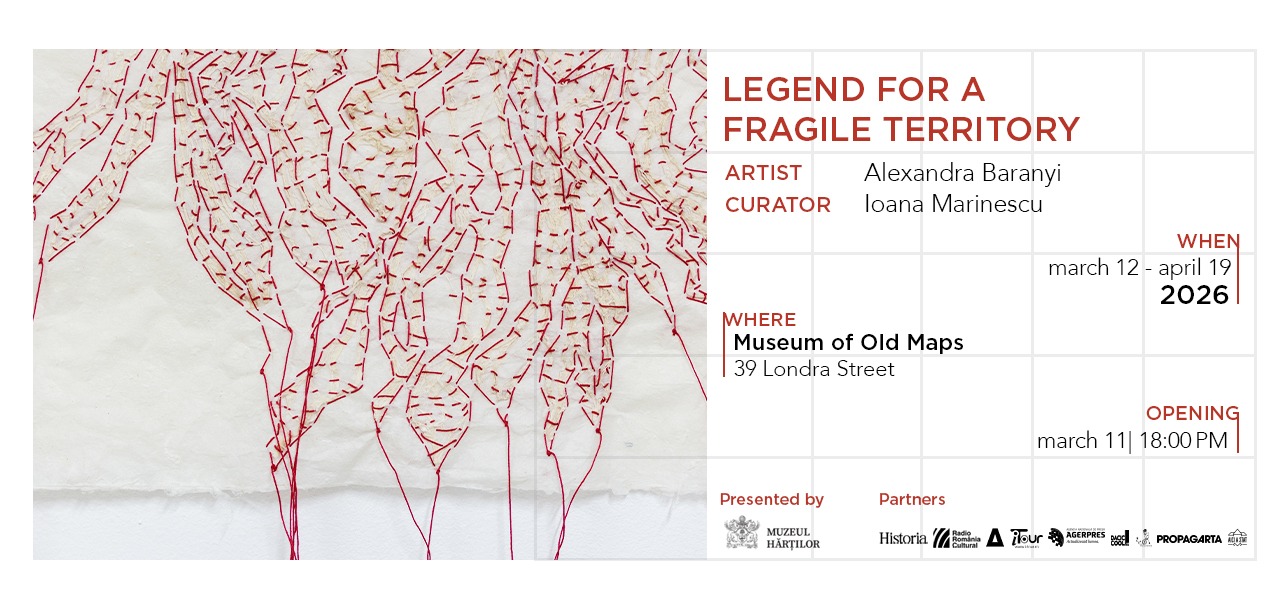
The Museum of Old Maps invites the public to visit a new temporary exhibition: Legend for a Fragile Territory by artist Alexandra Baranyi. Ioana Marinescu curated the selection and display of the works, while Andreea Barbu created the event’s graphic design. The exhibition explores personal and collective trauma as a psychological process. The paper functions as markers on an inner map, suggesting trauma not as an endpoint but as a transitional space and a possible premise for reconstructing the self.
The exhibition is open from March 12 to April 19, 2026, at the Museum of Old Maps, 39 Londra Street, Bucharest. Visiting hours are Wednesday to Sunday, 10:00–18:00.
Ticket price: 10 lei (full), 5 lei (seniors), 2.5 lei (pupils and students).
Tickets available online here.
Starting from the mapping of the invisible dimension of trauma, Alexandra Baranyi’s exhibition proposes a rendering of a territory that is, by definition, difficult to perceive: personal and collective trauma. To explore this theme, the artist uses handmade Japanese paper, produced in her own studio in Bucharest. The sculptural forms on display are not merely aesthetic objects; they function as inscriptions on an inner map, suggesting that trauma is not a final point but a space of transition and a premise for becoming.
In her exploration of trauma, the artist collaborated with Tamara Ulmean, a clinical psychologist and integrative psychotherapist. Together, they structured the legend of the “fragile territory” around four main themes: transgenerational trauma, relational experiences with others (transformative, traumatic, or formative), loss of connection with the self, and acceptance of wounds. The introspection, presented as a poetic narrative, concludes on an optimistic note, documenting the process of rebuilding the self.
The artist also constructs a chromatic legend:
“This series unfolds as a material journey through the layered formation of the self, following a chromatic progression: red, black, red, and blue. The initial red speaks of inherited memory and transgenerational imprint. Black brings structure and boundaries, reflecting the influence of family, society, and cultural norms. Red returns as the energy of confrontation and the desire for liberation, while blue marks a stage of reorganization and integration, where previous layers remain present in a new balance,” explains Alexandra Baranyi.
Another important component is the artist’s deep, multifaceted connection to Japanese culture. It includes her knowledge of Japanese, which she has also taught, as well as a long-standing familiarity with origami techniques. All these elements converge in her work, giving it a sculptural, minimalist dimension. This unique approach gives an apparently flat, fragile medium a plastic quality similar to that of hard materials used in sculpture.
During a doctoral scholarship in Japan, Alexandra Baranyi learned papermaking techniques from masters and artisans in the village of Echizen Washi. She later adapted this method and developed her own papermaking process using mulberry fibers and vegetable glycerin. This technique enhances the versatility of her work: the mulberry fiber becomes a plastic thread with which the artist sketches images and details of the fragile, invisible territories she maps.
The exhibition invites viewers to contemplate not only the surface of the works but also their own inner maps, to appreciate the strength of handmade material and to engage in a dialogue with contemporary art that can guide them in mapping their own sensitivities and limits, as part of a broader process of (self-)discovery.
Alexandra Baranyi (b. 1997, Timișoara) defines her artistic practice through a singular approach in which paper ceases to be merely a support and becomes, simultaneously, both medium and method. She constructs the artwork from scratch, combining the rigor and concepts learned directly from Japanese masters with a contemporary vision. Using handmade paper techniques learned on-site and adapted to her own practice, she develops a minimalist, sculptural aesthetic that challenges the material’s inherent fragility. Her works have been exhibited at Art Safari’s “Young Blood” exhibition, at the National Museum of Art of Romania, and in cities such as Tokyo and Venice, through the Romanian Cultural Institute and the Embassy of Japan.
Ioana Marinescu (b. 1988) is curator at the Museum of Maps and holds a PhD in art history, with a thesis on the biography of artist couples. Her professional interests include the image of maps in contemporary art. She is an author and editor of volumes such as Mapping: Narratives/Time/Space and MSGTL, published by Vellant, which present the work of contemporary Bucharest artists.