Expoziție Temporară
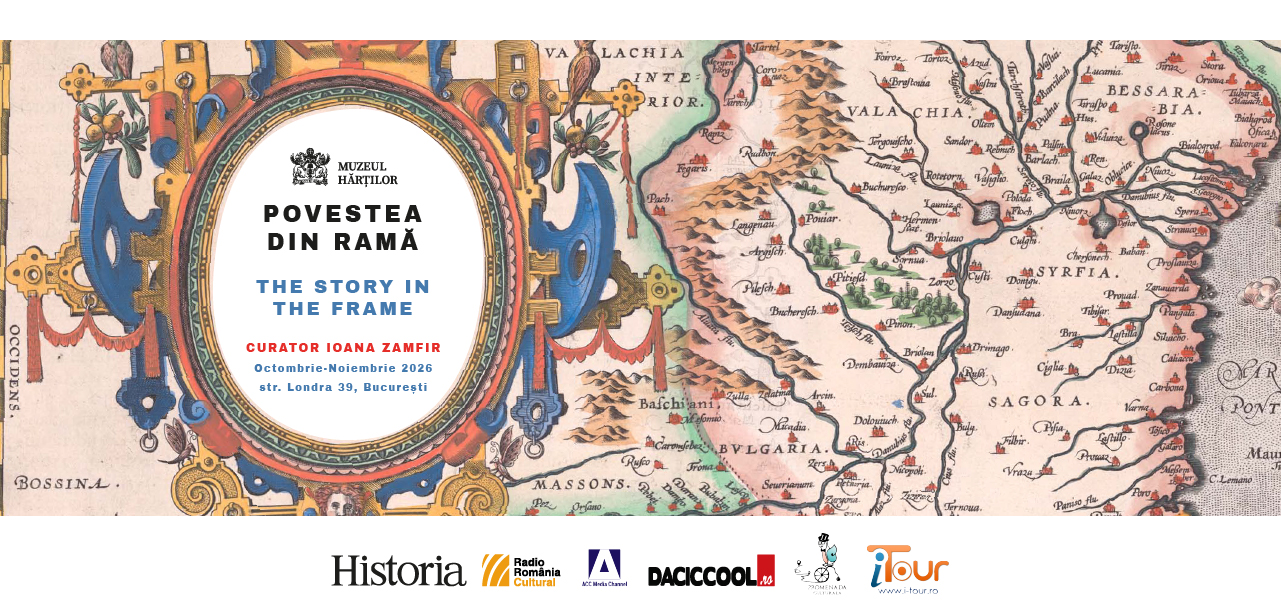
The Museum of Maps presents to the public a new temporary exhibition titled Povestea din Ramă / The Story in the Frame, curated by museum researcher and curator Ioana Zamfir. The event brings to the forefront map cartouches—a visual element in historical cartography that often provides the key to reading and understanding them.
Opening: October 1, 2026, starting at 18:00. Admission to the opening is free.
Exhibition dates: October 2 – November 15, 2026, at the Museum of Maps,
39 Londra Street, Bucharest.
Visiting hours: Wednesday to Sunday, 10:00 – 18:00.
Ticket prices: 10 lei (full price), 5 lei (seniors),2.5 lei (pupils & students).
Online tickets available HERE.
The exhibition displays a selection of over 30 cartographic documents from the Museum of Maps collection, complemented by reproductions from the Barry Lawrence Ruderman Antique Maps collection—an online platform bringing together rare maps, atlases, prints, globes, and old books. The initiative aims to capture the diversity of how this cartographic element was created, highlighting: mythological figures, personifications, portraits, geographical symbols, historical scenes, portraits of political figures or scholars, propaganda, and symbols of conflicting values and ideas.
Curator Ioana Zamfir explains:
“Through its shape, the cartouche conventionally demarcates different visual registers and indicates that inside it, we are dealing with a different type of information. More specifically, at the cartouche level, the convention of topographic mirroring claimed by the map stops, and beyond the frame we discover aspects regarding the representation itself: information about authors, patrons, scale, or the accuracy and completeness of the map. The message of a cartouche cannot be explained through a single theory applicable to every map from every era. Depending on the subject of the map, the cartouche can highlight the exoticism of a territory for commercial purposes; it can illustrate a power dynamic, an alliance, or a conflict when the map is involved in a political dispute; or it can resort to literary and mythological motifs when the map’s objective is primarily educational.”
The Story in the Frame invites visitors on a journey through the museum’s heritage, shifting the focus from geography and landforms toward the vocabulary and structure of maps, with the cartouche taking center stage. The term “cartouche” comes from the French cartouche, derived from the Italian cartoccio (“paper scroll”), which originally designated an architectural ornamental motif in the shape of a rolled parchment decorated with volutes. In cartography, it first appeared on 16th-century Italian maps and was later popularized by the Dutch. The heyday of the cartouche was during the Baroque period, when it gradually evolved into a true genre scene, connecting the territory to historical events, heraldic details, propaganda elements, and dynamics of dominance and conflict.
Ioana Zamfir is a museum researcher and scholar in the history of cartography, holding a European Doctorate (Doctor Europeus) from the University of Bucharest, defended with a dissertation on the image of Jerusalem in 16th-century cartography and travel literature. Since 2017, she has worked at the National Museum of Maps and Old Books, where she has curated numerous temporary exhibitions—including “Cristina Bobe. The Unseen City”, “Răstimpuri – Marcel Aciocoiței”, and “Precious Possessions – Estate Maps”—and collaborated with the “Grigore Antipa” National Museum of Natural History and the Câmpulung Municipal Museum for the exhibitions “Nature’s Maps” and “Câmpulung in Maps”, respectively. In 2025, she participated as a researcher and history of cartography specialist in HUMAN SCALE, the exhibition representing Romania at the Venice Biennale of Architecture. Her research, presented at international conferences (Bibliothèque Nationale de France, Max Planck Institute, University of Lisbon), has been published in specialized journals in Romania and abroad. She also recently published the volume “Hărți de Poveste – O călătorie cartografică în trecut” (Editura Niculescu, 2025), aiming to popularize historical cartography.
Barry Lawrence Ruderman is a well-known American antique map and atlas dealer based in La Jolla, California. His company, Barry Lawrence Ruderman Antique Maps, was founded in 1992 and specializes in maps, books, and atlases from the 15th to the 19th centuries. Their collection, based in La Jolla, San Diego, features over 13,000 artifacts, making it one of the largest and most respected in the field. They collaborate with universities, archives, private collectors, libraries, museums, and galleries on exhibition and research projects.
Media partners: Ziarul News, România Pozitivă, Radio România Cultural, Historia, ACC Media Channel, Promenada Culturală, AICI A STAT, i-Tour.ro, daciccool.ro, Zeppelin.